Wednesday, October 10, 2012

Five


10/10/2007

Friday, May 4, 2012

Fibonacci sequence, divine proportion, democratic order and the beauty of Nature

Watching the tv-series Touch, I came across some things I studied at the high school and the university, which i found very fascinating. I thought it was time to revise those subjects and i went to surf Wikipedia.
Of course the show does not dig the topic very deeply, but it gives a good hint for some thoughts.

Fibonacci sequence

Leonardo Fibonacci was a guy that lived around year 1200 and invented a particular sequence of integer numbers. Here the first numbers of the sequence:
0, 1, 1, 2, 3, 5, 8, 13, 21, 34, 55, 89, 144, 233, 377, 610, 987, 1597, 2584, 4181, 6765, 10946...

Apparently, for those not yet familiar with Fibonacci numbers, this looks a more or less random set of numbers. One can guess that it's a growing set of numbers (except for the second and third, which are equal), and the sequence diverges (i.e., as the numbers grow, also the difference between consecutive numbers grow), but nothing more interesting than that can be seen at a first look.

The series is defined by a very easy rule, and the number that compare in it are also very easily computable (so much that, to write those first ones above i didn't consult any table and i calculated them in my mind in no more than five minutes).
Here's the rule:
By definition the first two numbers are 0 and 1. The next ones are given by the sum of the two previous ones. Or, more formally:
N0=0
N1=1
For each n>1 Nn=Nn-1+Nn-2

This is a recursive definition, which means that the result, for a particular value of n, is given by the composition of the results of other values of n.
Given the definition of the rule, it is easy to compute the sequence:
N0 = 0
N1 = 1
N2 = N1+N0 = 1+0 = 1
N3 = N2+N1 = 1+1 = 2
N4 = N3+N2 = 2+1 = 3
N5 = N4+N3 = 3+2 = 5
N6 = N5+N4 = 5+3 = 8
N7 = N6+N5 = 8+5 = 13
N8 = N7+N6 = 13+8 = 21
N9 = N8+N7 = 21+13 = 34
N10 = N9+N8 = 34+21 = 55
N11 = N10+N9 = 55+34 = 89
...
Apart from the elegance of its definition, this construction looks completely artificial and totally useless, on the opposite, we'll see that in its extreme simplicity there are a big number of surprising practical applications. But no rush, let's meet the "golden ratio", first.

The Golden Ratio

The Golden Ratio, Golden section, Golden number, or, with some excess of drama also called "proportion of God", is a number given by the ratio of two lengths, so that the first is the middle term proportion between the sum of two and the second.
Given a segment AB we have to find an internal point C so that the length AC is the middle term proportional between AB and CB, or in other words:
AB: AC = AC: CB.
(AB is to AC as AC is to CB)

Naming AC=a and CB=b, the proportion becomes:
(a+b):a=a:b
The golden number φ is then equal to the ratio a:b
Its value can be computed as


It can be easily shown that also (a+b):a=a:b=b:(a-b)

The number φ, along with its multiplicative inverse has a load of interesting mathematical properties.
First of all
φ=1.618033988749894848204586834... is an irrational number.
Surprisingly Φ = 0.618033988749894848204586834... (for who didn't notice, the decimal part is identical!)
It is also true that the squared value of φ, φ2 = 2.618033988749894848204586834... (the decimal part is still identical!).

Another strange mathematical property is that
φ2 = φ10
and in general
φn = φn-1 + φn-2
which makes the sequence φn computable with a recursive function, just like Fibonacci numbers:
φ0 = 1
φ1 = φ
φ2 = φ10 = φ+1
φ3 = φ21 = 2φ+1
φ4 = φ32 = 3φ+2
...
One feature that seems remarkable to me is that the increasing exponentiation of φ calculate numbers more and more "almost-integer". I mean not exactly integer numbers, but irrational ones that approximate integers better and better.

As it happens to all irrational numbers, also φ can be expressed as a "continued fraction" (this, I really did not remember!). A continued fraction, expressed as a sequence of integers [a1, a2, a3, a4, ...] is the number calculated as

(of course for an irrational number the integer numbers that appear in the continued fraction is an infinite sequence).
Well, number φ can be expressed as the continued fraction [1, 1, 1, 1, 1, 1, ...], in this way:
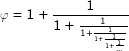
Since the sequence is made of all numbers 1, which is the smallest integer number, at any next step of the approximation, being that the number appears in the denominator, the largest possible amount is added. So, at the n-th step this continuous fraction calculates a rational number that approximates the irrational number φ worse than how any other continuous fraction, at the n-th step, approximates another irrational number. In other words φ is "the most irrational" number. The one that "escapes" the approximation more than all the others.

And, for someone like me, who gets carried away with Math as one nerd of the worse breed, these properties are already exciting, but there's much more.

The Golden Section was discovered by the Greeks in the sixth century AC. For the Greeks, the number 5 had a symbolic importance: it was the sum of the masculine (3) and the feminine (2). This property has contributed to give a kind of magical taste to the Golden Section, in fact if you draw a regular pentagon and its diagonal (obtaining a five-pointed star inscribed in a pentagon), the segments make a ratio to each other as φ : in Figure

AB:AC=AC:CB
But since CD=AC-CB, then also
AC:CB=CB:CD
AC is also equal to the side of the pentagon, so all the drawn segments in the picture are equal to the first, the last or the middle term of the proportion.

In the middle of the star, then, there is another regular pentagon. If you draw the diagonals to this pentagon, you obtain this picture:

which obviously has the same properties of the previous, and so on to the infinite.
Similar properties can de observed on the "golden triangle"...


The symbolic meaning of the Golden Section has influenced art. Fidia used the Golden Section to proportion the statues of the Parthenon (hence the use of the symbol φ - the greek letter for F - for naming its value). Leonardo used φ to map the Mona Lisa.

It's easy to find a lot of other examples just searching on the Net.

But, what does the Fibonacci sequence matter with the Golden section?
We take the sequence. We exclude the first number (which is zero) and calculate the ratio between the third and second, between the fourth and third, between the fifth and fourth and so on.
I threw this calculation in an Excel spreadsheet, and this is the result:

In the first column there is the index of the Fibonacci number reported in the second column, at its right. In the third column there is the value of the ratio between the corresponding number in the second column and its previous (obviously, not being able to divide by 0, I started from the third number divided by the second). You can easily note that the values of the third column converge very rapidly to the value of φ. On the right it's graphically shown this convergence.
Mathematically it can be said that

(as n approaches to infinity, the n-th Fibonacci number divided by its previous approaches to the Golden section)

Another strange fact about Fibonacci numbers and Golden Section, is the way they appeared in history.
The Golden Section, was invented by the ancient Greeks, but after the decline of the Hellenistic period, it went into disuse and had been almost forgotten for over a millennium.
Fibonacci in the thirteenth century invented his sequence, for applications that were totally unrelated to the properties of the Golden Section, and in fact nor he nor anybody else noticed that correlation, which was discovered only a few centuries later.
It's remarkable that Fibonacci was the first one that defined a recursive function, anyway ignoring its importance. Of course, the Golden Section and many other more ancient mathematical stuffs can be calculated using recursive functions (which I find really ingenious, even fascinating, as the computer dude I am), but their definition in this way was found only after Fibonacci.

Okay, you will say. They discovered two mathematical tricks and after more than one millennium they put them together. Everything very fascinating, but sill we didn't see what all of this is for.

Applications in nature

Take some squared paper and mark with a pen on one square more or less in the center.
Below, highlight the next sauqare in the same way.
To the right of it, draw a square adjacent to the two squares drawn previously, so that its side is 1 + 1 = 2.
Above this drawing, trace another adjacent square, with a side equal to the length drawn (2 + 1 = 3).
To the left of all these squares trace another one whose side rests to the other squares. The side of this last one will be 3 + 2 = 5.
Do the same thing below. The new square has side 5 + 3 = 8.
Continue like this until there's space on the sheet.
It's obvious that the drawn squares side lengths are equal to the Fibonacci numbers.

Now we can inscribe one fourth of a circle into each drawn square so that each circle is tangent to the one inscribed in the next square and the one in the previoius.

The curve that we obtained is called the Fibonacci Spiral.
To tell the truth, this is not exactly a "spiral": in mathematics, a spiral is a curve such that its derivative in polar coordinates is continuous in each point. Here, instead, it is not: the curvature is constant within each square but it has a discontinuity every where it goes to the next one. In other words, a "real" spiral cannot be drawn with a pair of compasses.
Anyway, the Fibonacci spiral is a good approximation of the Golden Spiral, which is a "real" spiral (a particular "logarithmic spiral" for which i omit the mathematical details).

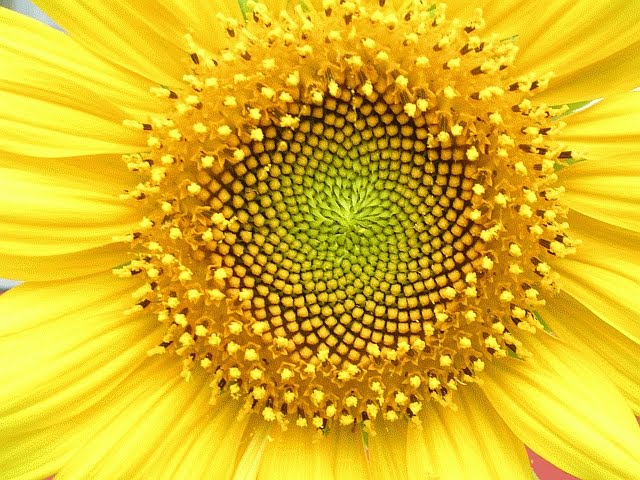
The beauty of all of it is that in nature there are a lot of examples of this spiral. One scenic one is the layout of the seeds in some flowers like the sunflower.

In the same way are arranged the elements of the pinecones, of the pineapple, the corn seed on the cob...

Then, there is the Golden Angle, which is an angle that divide the perigon in two parts between which the proportion is equal to φ.
In most of the plants and trees the leaves on the branches develop such as there is a golden angle between the previous and the next leaves.

There are several of cases in which different applications of the Golden section or the Fibonacci numbers can be noticed.
For example, most of the flowers have a number of petals even to a Fibonacci number (from Wikipedia: "Lilies have three petals, buttercups five, delphinia have often eight of them, calendulae thirteen, asters twenty-one and daisies usually have thirty-four or fifty-five or eighty-nine petals")

An explaination of this behavior in nature is given by the fact that, as we saw above, the Golden Section is the "most irrational" number.
For example, in the picture above, the fact that between each pair of successive leaves there is a Golden angle ensures that each leaf is "covered" by the subsequent ones as little as possible, and so it receives the largest possible amount of light.
Another reason, is that since Fibonacci numbers do not follow a replicable order, (which is an effect of their definition), each one contributes to the solidity of the whole. The idea is this: if the disposition of corn seeds on the ear was regular, say for example 50 seeds for each round, each seed would have been exactly aligned to those of the previous and the next rounds. The cob might break along those lines. Also on those lines where the seeds would lie would have been very crowded while the lines in between would have been empty.
Of course a solution of this last problem could have been that the seed were disposed as an exagone, like the cells of a beehive. In this way the seeds would have been spread as most evenly as possible. But one could anyway found an alignment (or better, three of them, at each other), and along these lines the alignment would weaken the cob.

In other words, even if nor the Golden section, nor the Fibonacci numbers have been invented for this reason, they both describe very well some behaviors of Nature.
I imagine that Darwin evolution developed some shapes that follow very well these rules, because they are winner on all the other schemes. The disposition of the leaves upon golden angles around the branches ensures a better insolation of the leaves themselves, with respect to any other disposition you can think of.

The democratic order

Recursivity, in the definition of the Fibonacci sequence, and then also in the Golden section makes me think of an order which is not imposed from the top, but built on the base, from the collaboration of the individuals themselves who suffer and benefit from the rule. The n-th Fibonacci number is difficult to calculate, unless you know its two previous ones. Knowing them, instead, the calculation is a piece of cake.
The arrangement of the n-th leaf around the branch is uniquely determined by the previous leaf, and itself determines the arrangement of the next one. So, the rule is not "centralized", but applied locally.
I think this is a good metaphor for democracy. Everyone contributes, through his small self, to build the order for the survival of the entire society which he belongs to. Everyone's right place is given by his ancestors, and will itself determine the right place of the future generations. And everybody have the responsibility to work within the rules, which are not imposed from the top but developed for necessity, and oriented to the conservation of the species.
I believe that humanity doesn't need an established power to regulate man's life. Rather, I believe that every man should acknowledge to be a part of a naturally organized society, and give up some ambition for the common good. The leaf that embezzle a place that it does not own leads to a deterioration of all the other leaves conditions, compromising the efficiency of the entire branch and therefore the survival of all the leaves (including itself).

(Lot of references and some pictures from Wikipedia)

Friday, January 27, 2012

Bon Camino


Me, on my way

Track of the excursion (view in bigger size)
It all started watching the movie The Way.
The plot is not a big deal, i believe, but it shows wonderful scenic landscapes around the path of Camino de Santiago. At the end one feels inclined to take the same adventure.
The movie, in my opinion, focuses the true spirit of a pilgrimage, whidh is not simply a journey to a destination. Yes, we need one destination is needed, otherwise we would miss a reason to travel. The real significance, however, is not to be searched in what you reach, but in the path itself to reach it, as death is not the purpose of our lives, but only a phase, albeit important. Somebody say, although without any proof, that for an immortal life has no reason.
The movie describes a pilgrimage along the "French Way" (one of the variants of the Camino de Santiago de Compostela), strictly by foot.
The entire route is about 800km long. Assuming you divide it into 40 daily stages, each stage is 20km long on average.
Who likes mountain hikings (the first stages of the journey crosses the Pyrenees) knows that the difficulty cannot be simply measured in kilometers, so it is difficult to say whether 20km in length are easily overcome. The only way to decide is to try.

No sooner said than done.

Since we live in the mountains, and the difficulty of the roads and trails in these parts seems more or less similar to those shown in the film, one day, more precisely last 1st October, map in hand, we planned a circular route about 20km long, starting from our home.
The first part is on the asphalted road, on the route described here until you get to take the path described here that reaches the peak of mount Tesoro. This is the highest point

Break for a sandwich
of the entire route, and here begins the descent. You follow the path until you find the road at Forcella Alta, the starting point of pass Pertüs excursion, but here, instead of going straight, you follow the asphalted road downhill. A few hundred meters further, it becomes a white road. Traffic is blocked except for authorized vehicles. Here you follow for Boccio, until you come to a small church, where we stopped to eat a sandwich. Shortly after you turn towards Colle di Sogno on a path pretty flat which looses among the fields (in fact we got lost and we were forced to retrace our steps and to ask for directions to some suspicious residents: it looks it's not very common here to see other human beings). Here we enter a beautiful trail in the woods, a little ups and downs, and we arrive to Colle di Sogno, a small mountain stone village, with narrow pedestrian alleys. There is a tavern where we stopped to buy a bottle of water, as our reserves wew already exhausted long before. The locanda looks cozy and with tasty food: we mark the intention to visit again in the future. After crossing Colle di Sogno, we reach a small parking lot, which is the limit of the asphalted road if you come by car the opposite way. We follow that road. From here a long panoramic descent crosses Sogno village, and reaches the junction with the road to our house. One last short climb, and we get home.

We are very tired, yes, but it's not that terrible. Our dogs are truly exhousted. If we decide to actually do the Camino de Santiago we have to leave them at home. Paradoxically, the paved road for them is even harder, because it is abrasive to their feet. Moreover, Spain does not seem very dog-friendly. The hostels along the Camino, for understandable reasons, do not host dogs. Only a few of them allow you

View from Forcella Alta
to tie them in the yard, but this solution, especially for the unsociable Mr. Bentley, is not really feasible. Finally, man's best friends are not accepted on public transport, and then, once we arrive to Santiago, we would not know how to return to the starting point.
The insurmountable problem, however, seems to be the time (isn't it a paradox, talking about a pilgrimage?). At now, I don't have the opportunity to take 40 days off or, considering the time needed to reach the starting point and to go home, even more, not counting any unpredictable event that may happen during the journey.
Therefore, unfortunately this is a dream to keep in a drawer, until I'll be able to completely change life style.
One can plan to make only a part of the whole Camino, or to make the whole of it dividing it in parts. But it would not have the same significance. They say that even the latest stages are a little less compelling just because a lot of people join only for those stages, just for the satisfaction of saying they reached the goal. I think this is proof they didn't understand anything.

The route is quite easy, but pretty long: 23km in total (14mi), the difference of level is about 2500 feet, and we took 7.5 hours.

Friday, December 30, 2011

Da Bus


It is a cliche that the Hawaiian tourism is a somehow elitish. In fact, given the location in the middle of the ocean (the islands are quite distant from anywhere one arrives), the feeling is something exotic. From California it takes five hours by plane, so, it is not exactly cheap just to get there. Not to mention the cost in terms of time and money, if you come from Italy!
Therefore, if you land to Honolulu, what you find is a type of tourism a little snob, walking into shopping streets, tanning at Waikiki beach. In the traffic many limousines can be seen.

Instead, the Kaua'i island is a bit apart from the typical touristic Hawaiian destinations. And the most common public transport is The Kaua'i Bus, familiarly Da Bus (slang for "the Bus").
Unfortunately, if these buses are used by residents, we can not say the same for tourists. I suggest to all those who go on vacation to Kaua'i to ride them, because they are comfortable, cheap, efficient and you can experience better the local customs.

The service, atleast for the trips I have experienced, is very good. Always on time and with frequent departures.
Of course cars are more comfortable, since the bus has to respect the schedule and it takes time for the intermediate stops. But it does not force you to pay attention to driving and you can concentrate on the landscape outside the windows.
The fixed cost of a ride (no matter how long it is) is two dollars (not exactly cheap, if it is a short distance, but very convenient if you consider that you can run around the island). You don't need to buy a ticket before, you just put the money in a box next to the driver. Much more convenient, as we did, is to buy a pass that entitles you unlimited use of all the lines for a month for $25.
In the town of Lihue there are a few lines that make urban service, including there is one funnily named "Lunch Shuttle", scheduledin the hours around noon. It stops at the most common restaurants/fast-food (I imagine that it is used by workers in their lunch break).
Out of Lihue the lines make both urban and suburban service. They go on the highway and make frequent detours in the residential areas, reaching hospitals, schools, shopping centers and places of public utility.

The nice thing of Da Bus is the friendliness of the service. Often the driver use to chat with passengers. Once I heard him singing along with the radio on "It's aloha friday, no work till monday", a very common Hawaiian pop song, and then, addressing the passengers screaming "This is my song, friends!" Happy at the thought of the weekend starting soon. Another typical driver was the one that took us a couple of times in Poipu: a "grandma" with a hat adorned with cute little flowers, driving so slow despite the nearly empty streets. At each stop she announced its name, even if we were the only two passengers, and she knew our destination (they ask, sometimes, for statistical purposes).

Even the passengers are generally relaxed and friendly (what a big difference with Milan underground!), And never fail to greet when they enter, and thank the driver when they exit. There is ervery kind of people: the boy and the girl flirting, the guy dressed like Michael Jackson trying to attract attention, the businessman who does leave the cellphone alone, the grandpa who smiles to everybody who meet his gaze. In any case, most times you end up chatting with someone you meet on Da Bus or at the bus stop before boarding, as if there was some kind of brotherhood among all those who use Da Bus.

It would be nice if the service worked even at night, so one could use it for the nights out. Also, i think the lines should be enhanced to some destinations, for example, there is no bus that goes up to the mountain (that could be because the towns are almost all connected by the highway that runs on the perimeter of the island).
In general the service is very good for the destinations of the locals, but not enough for the tourists. The beautiful Poipu beach, for example, which is on a detour from the highway, has its own line, but the trips are not frequent enough, which forces you to spend a lot of time waiting for the bus.
One thing I find objectionable is the custom to keep the air conditioning at high level. It's advisable to bring something extra to erar, in consideration that, outside, you are always in shorts and T-shirt.
In the front of the bus it is arranged a rack that can hold up to two bicycles. This service (i think for free) is frequently used: the cyclist secures the bike and then rises on the bus. I wonder if you have to reserve this service in advance by calling Da Bus people (if not, what could happen if there are more than two cyclists on the same trip?). Of course the buses are equipped with a lift for handicaps and spaces to accommodate wheelchairs.
The service is perfectly sized (I think this is the reason for the statistics I mentioned above): The seats are often all occupied, but it rarely happens that someone has to stand. Only once it happened to me, during students rush hour, a trip was crowded (but nothingcomparable to public services in our cities).

In short, if you appreciate the atmosphere of calm and comfortable relaxation you can breathe in Kaua'i, Da Bus is the best way to visit the island.

Also for this post, the photos are by Rowena

Tuesday, December 20, 2011

Tropical hiking

Hiking in Hawaii is definitely a different experience for those like me, accustomed to Alpine mountain trails.
First of all, the climate. The humid heat makes movements more strenuous. Also, the paths tend to be covered by the quite intrusive tropical vegetation: the undergrowth ferns hides the tracks and make it a little disorienting. Also the rocks are hidden by vegetation, so the painted signs, if any, cannot be seen. Moreover there is not a valuable service such as CAI (Club Alpino Italiano) who maintains trails and markers.
Fortunately the hikers theirselves put and renew indications with colored ribbons tied to the branches every now and then.


GPS track of Honopu excursion.
View the map in a bigger size
Honopu ridge, October 16, 2011

The signaling ribbons (orange and pink) were indeed very useful during the first of our two trips into Kaua'i island. R's son and his girlfriend came with us

Reached the beginning of the path by car, we followed the directions outlined here. You enter the forest, which, in descent, becomes more and more intricate. At one point the path becomes very humid and you end up slipping.
When the forest opens you are on the edge of a steep slope especially, pretty easy to overcome if not for people like me, who have an innate dislike of the precipices. Fortunately it's only a small part, and finally you go back into the forest. At the end the view over the beautiful coastline of Na Pali is breathtaking.

View from the end point
To tell teh truth, from here, the beach (about 3500 feet below), cannot be seen. But you see the side promontory that forms, along with the one under your feet, one of the magnificent Na Pali bays. Within the valley one expects to see emerging from the vegetation the necks of the brachiosauruses, which, exactly here, have been the protagonists of Jurassic Park. Instead, you can see the birds (they are actually just tiny white dots). Every now and then, far below, a touristic helicopter passes, barely visible. Other white dots in the ocean must be boats (the beaches in the small bays below are inaccessible from the land).
You are on the crest of the hill so, looking to the other side the view opens up to another valley. In the distance it appears Ni'ihau island, the Forbidden Island.
From here the path goes down rather steep (and apparently not very safe), always on the crest. It does not seem to promise a better view of this. Satisfied and aware that the return is quite all uphill, we head back onto the same path.


GPS track of Makaleha excursion (the inaccuracies are due
to the bad satellite receptions in the forest)
View the map in a bigger size
Makaleha Falls, October 17, 2011

Also interesting, though completely different, was the other excursion.
This time, in addition to the four of us, there were also R's brother and sisters, with their husbands. The guide was D, the brother, which had already come here long ago. The path goes up folloowing a stream, and has several river-crossings and parts with slimy mud. Warned in time by D, we have adapted our equipment to these conditions. Hiking boots were not right: we then purchased the "Tabies", special rubber boots, flexible, with soles thick but soft and covered with a layer of a material similar to velcro. Without this type of footwear it is impossible not to slip. In addition, the adhesion of the rubber to the ankle, similar to the one of a diving suit, helps to lift the foot when it is stuck in the mud.

Ford
The route is varied, almost always surrounded by dense forest. At some point it passes very close to a huge monolith shaped like a cube, which looks like a dice fallen from the hands of a giant. Then suddenly you enter a surreal place: a bamboo forest. The canes, huge and high, take the place of trees, leaving, between each other, enough space to unravel. A few hundred meters, and just as suddenly, the vegetation of ferns and tall trees reasserts itself. Here the trail is lost, even if it is not difficult to guess the direction, as you continue to follow the course of the river. But your must walk on the trunks of fallen trees or branches, covered with slippery moss, clinging to other branches or rocks to keep balance. You can not see the dirt, the vegetation is too intricate, but judging from the level of the water, you are about one-two meters from the ground.
The humidity is a lot, and after a few hours of walk, it turns into rain. The weather suddenly changes in the islands, so we judge that it is much safer to retrace our steps. Too bad, because D says that in the end of the path (another couple of miles) there is a pond where you can take a shower under the waterfall.

Wonderful excursions. When you go to Hawaii for vacation, you think about beaches and ocean waves, but in my opinion, especially in Kaua'i, the Garden Isle, it is the haunting beauty of the untouched interior to leave you breathless.

There is something intimate in the experience of walking in nature, and it was nice to share it with my in-laws. It feels as if this experiences created a bond among us.


Me, in the bamboo forest.
All the photos of this post are by Rowena

Monday, November 21, 2011

Sit down, relax, eat, eat, eat...

That is a welcome expression Hawaiians like to use. Even there, as in our culture, food has a social value, but the meal has a different look. The difference lies in "geometry". In Italy we eat all sitting around the table together (it is even considered rude to start eating when anybody is not yet ready). In Hawaii (and, I believe, generally in the States), the buffet style is more common. Everyone serve him/herself filling up his dish. It is not uncommon that not to have a table at all. Everybody eats the way he wants: standing, sitting on chairs or armchairs, allowing the events to make big or small groups for conversation.

Luau
Luau is a word in the native Hawaiian language which means more or less "party". The spirit is to meet somewhere to share the pleasure of being together. Traditionally, the guests bring the food which is then shared among each other.

The luau I attended during my Hawaiian holidays was organized in the Community Center, to celebrate of my wife R's family reunion.
All the close relatives of the families originated from the defunct R's grandmother were invited. We were about two hundred: a success, given that most of those relatives are distributed pretty much all over the world.

The most typical character of the party was Patty Boy, a cousin of uncertain age with long bushy white hair collected in a ponytail. Deep and loud voice. When we arrived, together

The Luau dinner
with my sister in law and her husband, Patty Boy immediately ran towards R's sister (who lives in Washington State) embracing her with a hearty "Welcome to my cos from Italy". When we notified him the mistake, he repeated the same formula for R, and hugged me warmly shouting "Thank you for taking care of my cos".
Patty Boy, as a gesture of welcome, put on my neck a ti leaves lei, and responding to my "i am honored" he didn't loose the opportunity to point out (perhaps with excessive pathos) how lucky we were to live this occasion to strengthen our family unity.
I think Patty Boy embodies at all, almost as a caricature, the totally sincere welcoming spirit of Hawai'i.

The dinner was arranged on a long table with large trays, pans and serving dishes. Our contribution couldn't be anything but some typical Italian food: we filled a considerable number of cannoli shells with sweet fresh ricotta and candied fruit. The result was not bad at all, in fact they disappeared in few minutes.

Kalua pig

The Kalua pig preparation
The most typical food of the table was the kalua pig.
This is the native Hawaiian way to cook the pig: once wrapped an entire pig in banana leaves they bury it in a hole in the ground in which some hot stones were put. The pig is then covered with hot stones and sand. After a considerable amount of time they take put the sand and stones and unwrap the pork form the banana leaves, ready-cooked.
We were fortunate to be able to assist in the preparation of kalua pig with methods a little more "evolved". The pork was wrapped in banana leaves and aluminum foil and placed in a metal cage. The cage was sittinh on hot stones in the hole, and everything was covered with wet rags and a special plastic sheet. We have come to the place of preparation during the afternoon, when the kalua pig was being "unburied", and we had the opportunity to taste it still hot.

Poke
Typically, the kalua pig is accompanied by the poi, which is like a gray-pink and sweet taste puree, made out of taro, a tropical root. The poi must be eaten picking it up from a bowl with two fingers ("two fingahs")

Poke
Another typical way of eating in Hawaii is the poke. It is a snack, rather than lunch or dinner. The poke is sold in the deli of small supermarkets, supplied directly from local fishermen, as it happens in Hishihara market.

The chef at Chicken in a Barrel
The fish is cut into "bite size" cubes and marinated in spices and sauces. It is usually eaten with chopsticks.

Chicken in a Barrel
An enjoyable experience is to have lunch at little banquets on the roadside by the sea. Chicken in a Barrel is one of them.

Saimin
A single character with cowboy hat accepts orders from a window in a wooden small house, cook the chicken on a barbecue made out of a barrel and serves at tables arranged on the lawn surrounding area.

Saimin
Hawai'i islands are a repository of traditions brought there by immigrants from different places at different stages of history. Great is the Japanese community, so, popular is the cooking from Japan. One of my favorite places is Kintaro japanese restaurant, where I tasted the best sushi of my (limited) experience. But anytime i go to Kaua'i i never miss to go atleast once to Hamura Saimin. The saimin, the restaurants and the operators are very similar to those described in the movie The Ramen Girl. "Saimin", in fact, is the Hawaiian name of the ramen. The menu is rather limited, but no matter. The only order that makes sense over there is, in fact, the saimin.

All the photos of this post are from R's blog: http://rubbahslippahsinitaly.blogspot.com/

Friday, October 28, 2011

Deja-vu...?

What strikes you, As soon as you exit the plane at Lihue airport, is a strong sense of deja vu.
Actually, no. Deja vu is not the correct expression in this case, because, one could argue, it would be obvious that you feel you already saw a place ("deja vu") if you have already been there (and I have already been several times at the airport of Lihue).
It is rather some states of mind that you feel inside, in your lungs, in your stomach. You feel it, but you can't realize what it exactly is.
I believe that this feeling is evoked mainly by smell. Of cinnamon and ginger, but, above all, of very ripe fruits. A sweet smell, a little sticky (maybe even for the high rate of humidity). Not unpleasant at all, but very strong. It also hints of peat and fat undergrowth. The island smells very different from where i live. It almost seems to recognize something ancestral and primitive, which belongs to my genetics, but without any cultural tie, in this sense deja vu. Like it is for a lion roar: it would scare anyone, even those who had not ever heard its sound.


Kealia bay
You perceives something different also about hearing. Not the usual reverb of some sand between heels and fake-marble floors, typical in the airports, with artificial aseptic and metallic voices in the background. Here the speakers spread sugary Hawaiian melodies, the announcements always begin with aloha and end with mahalo. Everything comes a little muffled to the ears (maybe also for the warmth and moist of the air, after the air conditioning there was in the aircraft). This feeling is even increased when you exit the airport, and there is constant noise of the surf on the beaches or the waves crashing on the cliffs.

People are extraordinarily, almost irritatingly calm and quiet. With haoles (as i look - and i am) they are all very friendly. With the locals (like R) they start to speak strict pidgin seeking - and usually finding - common friends or relatives they share.
The cars move slowly and the traffic rage simply does not exist. The flow of events is not managed by clocks but instead by the availability of time of whoever is involved. Almost one wonders how it is possible that society respect schedulings designed on absolute time (eg public transport timetables).
This time we landed at night, but I like to arrive to Kaua'i during the day, because all of the sudden it offers, from the highway, some dramatic views of the mountains, similar in shape to the Dolomites, but colored with different shades of green (in the tropics vegetation is able to invade every available space). From a distance they look almost surreal, the colors a little blunt by humidity.

The best tasting food is the tropical fruit. I stuffed my face with papayas - who has never been to the tropics can not understand: the papayas we have in Italy taste like plastic, while over there they are sweet and buttery. Mangos, avocados, pineapples, star-fruits, bananas of every size and flavor, coconuts, typical macadamia nuts, lemons, limes, pomelos, passion fruits. At Kaua'i you can find wholesome and tasty goods at the farm markets (markets where fruit and vegetables are sold directly by the producers.)
And then there's the fresh fish, which is also sold in form of poke (raw fish salad dressed with sauces, spices and seaweeds, to eat with chopsticks).
Wine is unusual, but the beer flows is like rivers...
To food a specific post will be dedicated. After all, the reason (or the excuse) of our holiday over there was the participation to the typical luau, at the family reunion.