Canzo is a little village in the province of Como, on the mountain road that links Bellagio to Erba. Here, every year on the last Thursday of January, the Giubiana is burnt.
The ritual stake of the Giubiana, in other places called Giubia or o Giöbia, is a tradition that repeats itself every year in several villages of northern Lombardy. The name comes from Iovis (Jupiter), which also gives the name to the day of
giovedì ("Thursday"), sacred day to the pagan god. The Giubiana is a woman, often an ugly and evil old witch, elsewhere she can be a pretty but mean girl. In any case, she is the personified guilt of the evils of the previous year, and her death by fire represents a hopeful wish for the newly begun year.
It would seem a cruel and chauvinist ritual that evokes times of the Inquisition, and undoubtedly its origins are born directly from those episodes, but tradition is tradition, and it must be respected as is.
At Canzo in particular, the celebration is very elaborated and participated by the citizens. It is a kind of theatrical performance around the streets of the center town, in which the Giubiana, bound to a cart led by a donkey, is first taken in a procession to the market square where the trial takes place. Then, once judged (the process shouldn't leave any guesses to a final other than the verdict of guilty), everybody goes to the meadow "delle Stelline", where a pyre is ready, on which the puppet of the witch is set upon and burnt.
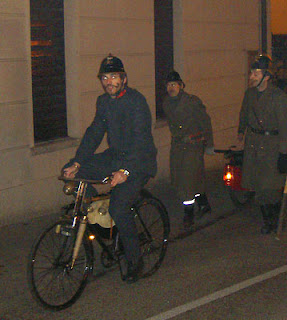 Pumpier in bicicleta
The Giubiana of Canzo is played entirely in the local dialect (similar to Milanese
Meneghino, but with rural influences). As an effect of globalization, Lombard dialect is slowly but inexorably disappearing from our lands, and it is unusual to hear it perfectly spoken, in this occasion, also by children. Honors to the organization for keeping this tradition alive, in which run deep our origins.
The play includes a large number of characters, every one with its role, and involves a big part of the citizens. Here, the characters, in order of appearance in the procession (the italic is the original dialect version):
-
i pumpier in bicicleta (the firemen in bicycle), from the procession to the trial, their task is to ensure just procedure of the process and the execution of the penalty, with particular attention to the dangers of the fire, an ever present element. Also the bicycles are vintage and equipped with a little cart with a manual pump-hydrant.
 Cilostar
-
i cilostar (the candle-holders), they wear black masks and red tunics, and they hold big candlesticks to light the procession to win over the oblivion of the dark.
-
il pastur ca suna 'l cornu e l'alpée ca 'l porta i corni dal bech (the sheppard that plays the horn and the mountain man which holds the horns of the goat)
-
i buschirö (the woodsmen), with their vintage tools,
-
'l carett di paisan (the cart of the village people), pulled by a donkey that transports the Giubiana who is guarded by the
boia (executioner) in a black cassock, its face covered by a black hood.
-
al train, a cart full of sticks and twigs, symbols of the mountain winter economy
-
al Barbanera cui pianètt dala furtüna Mr. "BlackBeard", that distributes good luck with his cards,
-
i bagai, bei e brut bun e gram (the kids, nice, ugly, good and bad ones). The nice and good ones have the face colored in white and play the bells, the ugly and bad ones have black faces and rattle
i toll e cuerc, cans and pot covers,
 Cilostar, Pastur, Alpée, Regiuu
-
i Regiuu vestiti cul capèl e 'l tabar (the elderly people, wearing hats and capes). Lombard society was organized in large families; in the same courtyard lived three to four generations. The elderly members were respected and played the role as consultants for solutions regarding disagreements and important decisions,
-
L'aucat di caus pers (the lawyer of lost causes), defender of the Giubiana in the process, his role clearly showing that his involvement is only because of her money,
-
i testimoni dal prucèss e la cumar dala Contrada (the witnesses of the process and the godmother of the quarter) will speak during the process, some in favor, some against the Giubiana.
-
i stria picitt ca fan strimì cun la magìa - e i diauj dala bela vus (the spooky kids, that scare with their magic - and the devils with the nice voice) that sing the ode to the Giubiana,
-
l'urzu (the bear), symbol of instinctive strength that must be tamed,
-
al casciadur ca duma e fa balà l'urzu (the hunter that domesticates the bear and make him dance),
-
l'om Selvadigh (the Wild man), very ancient symbol of Alpine culture, he is the one that lives in harmony with the woods and knows the secrets of nature, he comes from the silence of the forest,
 Giubiana and Boia
-
l'Anguana, mysterious good fairy, symbol of water as vital feminine element.
The beating of the drums constantly underline the main phases of the play; the band follows the procession playing a grotesque funeral march.
People spontaneously follow the procession to the square and listen to the process.
The process includes a listing, by the witnesses, of all the negative events that happened during the whole of the previous year, obviously to put guilt on the Giubiana. Aside from the typical peasant themes linked to weather conditions and other natural occurrences, there are chronicled facts. The 2008 Giubiana, in fact, was guilty of the war in Iraq and all the unfortunate people that are dying for it, of the ozone hole, of global warming, of the economical crisis, of the trash emergency in Campania...
Of course the enactment of the Giubiana of Canzo doesn't give pretense to find a real fault for these negative things, but it makes us think of how good it would be if we could win them simply by burning a straw puppet. To solve the evils in the world is another thing altogether, but simply naming them in a social rite can help us at least to recognize them, which is not often expected...
Thanks to
Rubber Slippers In Italy for the photos and the video.
Informations on the
Comune di Canzo website.




